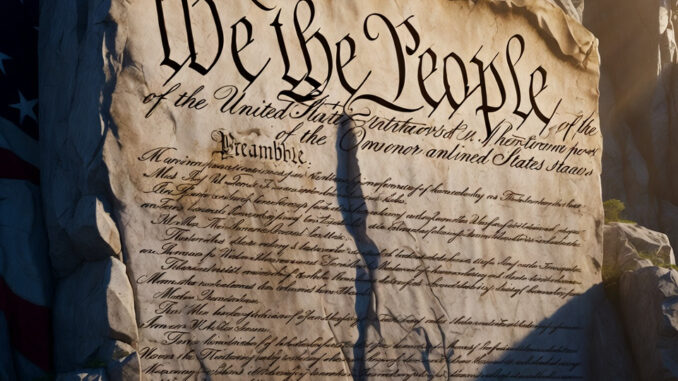
The Constitution is not a “living document” that judges can rewrite whenever society changes. It is a fixed contract among “We the People” and our posterity. The framers made it deliberately hard to amend. They required two-thirds of Congress and ratification by 38 states. They did this precisely because they never intended it to evolve through judicial reinterpretation. That difficult process is its own testament. They wanted the meaning locked in unless the American people, through supermajority consensus, chose to change it.
The Problem with Living Constitutionalism
Yet today we have judges and scholars who treat the Constitution like Silly Putty. They call it “living constitutionalism” and claim the amendment process is “too hard” for modern problems. So five unelected lawyers must “update” broad phrases like “liberty,” “due process,” and “equal protection.” This is not interpretation. It is legislation from the bench. It is exactly what the framers designed the Constitution to prevent.
How Living Constitutionalism Abuses the Fourteenth Amendment
Take the Fourteenth Amendment, the favorite tool of living constitutionalists. It was written in 1868 to protect freed slaves and their children after the Civil War. The Citizenship Clause and the Equal Protection Clause were aimed at securing citizenship and basic legal protections for people who were born here and owed complete allegiance to the United States. The floor debates in the 39th Congress are preserved word-for-word in the Congressional Globe. They are crystal clear. Senators Jacob Howard and Lyman Trumbull explained “subject to the jurisdiction thereof” as meaning full political allegiance. It was not mere physical presence after breaking our laws.
Yet modern courts have stretched “person within its jurisdiction” far beyond that purpose. Plyler v. Doe (1982) used it to force states to provide free public K-12 education to children of illegal entrants. They even cited Yick Wo v. Hopkins (1886), a case about a long-term lawful Chinese resident who had lived here openly for decades, as justification. But Yick Wo was here legally. Illegal entrants are not. The distinction between legal and illegal presence is obvious, logical, and consistent with the original meaning of the compact. If someone never joined “We the People,” they do not get to claim the full protections of the document they violated to get here.
This selective expansion creates the exact “all or nothing” absurdity I wrote about earlier. Courts give illegal entrants due process and equal protection in some areas such as education and detention challenges. But they deny them others such as voting and gun rights. That is not principled judging. It is policy-making that rewards lawbreaking and burdens the citizens who actually are parties to the constitutional contract.
The Weak “History Is Messy” Excuse
Critics of originalism love to say “history is messy” and “we can’t know the exact meaning.” That claim is weak. It borders on willful blindness. We have the Federalist Papers, Madison’s convention notes, thousands of letters in the Founders’ correspondence, full floor debates for every amendment, and contemporary newspapers. For the Fourteenth Amendment we have exhaustive records showing exactly what the ratifiers meant. When the historical record is this rich, claiming ambiguity is just an excuse to substitute modern preferences for the fixed public meaning.
Abortion as a Test Case
Abortion offers a good test case where things feel messier. Some originalists argue it has zero constitutional dimension because it was regulated or banned at the time of the Fourteenth Amendment. I think that view sometimes overreaches by ignoring any medical dimension. At the same time, living constitutionalists invented a sweeping national right out of thin air in Roe v. Wade. Both sides misuse the document.
The Constitution is silent on abortion. The honest answer is to leave the issue to the states. We should define “medical treatment” clearly and uniformly. Legitimate medical treatment during pregnancy is about saving lives, both the mother’s and the baby’s. If the mother is at higher risk while carrying, the proper response is delivery via C-section or early induction, with every reasonable effort to preserve the baby’s life. The only time ending the pregnancy qualifies as true medical treatment is when the baby has no realistic chance of survival anyway, such as a tubal or ectopic pregnancy. In those narrow cases, priority shifts to saving the mother.
That definition can be debated and enacted by legislatures. It does not require inventing a constitutional right, nor does it demand a reflexive federal ban. The framers made amendment hard because they wanted difficult moral questions resolved by democracy, not by judges.
Why Originalism Wins
Living constitutionalism erodes the rule of law, undermines sovereignty, and turns the Supreme Court into a super-legislature. Originalism respects the text, the history, and the deliberate design of Article V. It keeps the Constitution a stable compact among “We the People” instead of a blank check for whatever five justices feel like on any given day.
That is why I reject the “living document” theory. It was never what the framers intended, and it is not what the American people consented to.
If you’d like to comment, or push back, please stop by the post on X.